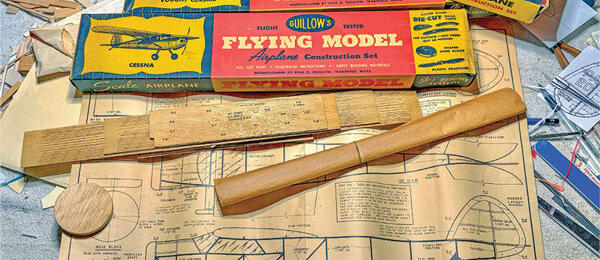
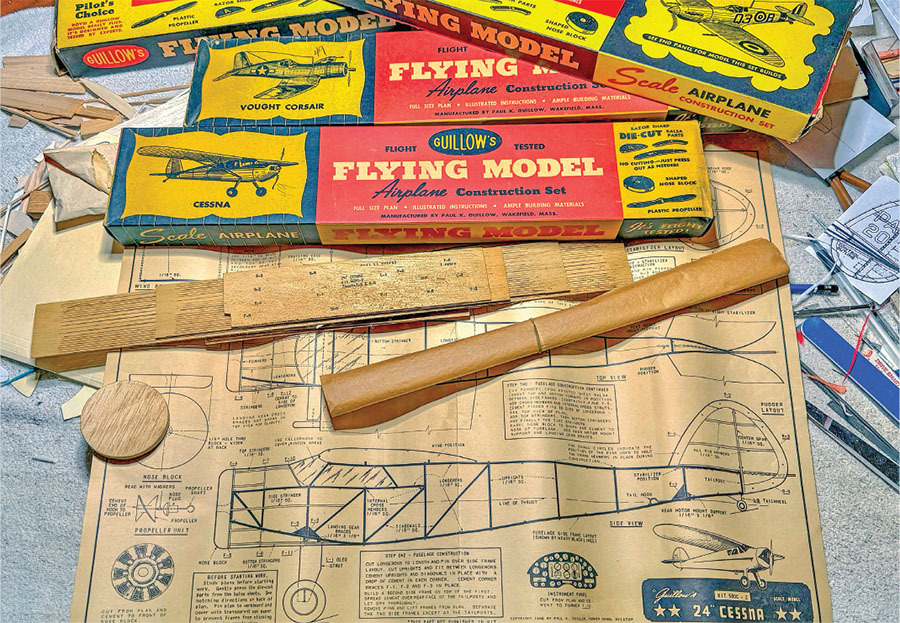
THERE’S A BUZZ in Free Flight (FF) Scale circles this year as we shift gears and focus more keenly on celebrating the 100th anniversary of Guillow’s. Specifically, the Flying Aces Club (FAC) will feature Guillow’s models this July in the 40-plus events at the FAC Nats in Geneseo, New York. Additionally, there will be an International Postal Contest that lasts until December 31.
The International Postal Contest includes three categories. The first will be for the commonly available Modern Era kits, which line the shelves of most hobby shops. You must use the kit’s wood and plastic parts, although there are a few modifications that are allowed. Second, there’s a category for Classic Era plans and kits, which began in the mid-1930s and lasted until the mid-1950s. The models can be built using your own wood, with a few modifications that are allowed as well. Third, the Classic Era models can separately be flown indoors.
I expect to see a lot of action from all three categories this year. A link to the complete list of rules can be found on the FAC website, which is listed in "Sources." You can also find a link in "Sources" to download a folder of 58 Classic Era plans that are free to anyone who wants to take the deep dive.
I’ve offered to be the contest’s record keeper, so keep those photos and entries coming to me at my email address, which can be found at the beginning of this column. Please include your name, location, and your best flight time, along with a photo of your model(s) as verification. Enter as many models as you would like. Fly as many times as you are able, but only send in your updated best flight time. The top fliers in each category will receive a kanone (competition victory), along with the admiration of the FAC FF community.
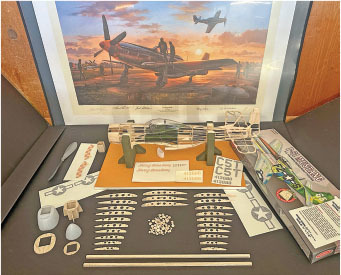
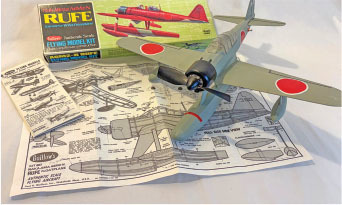
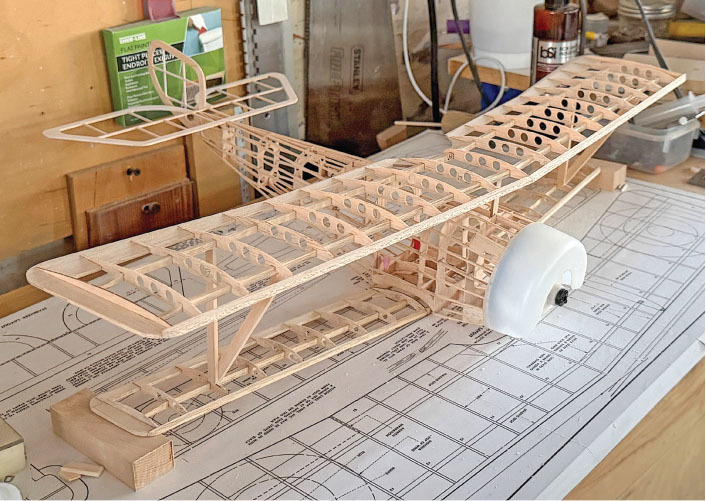
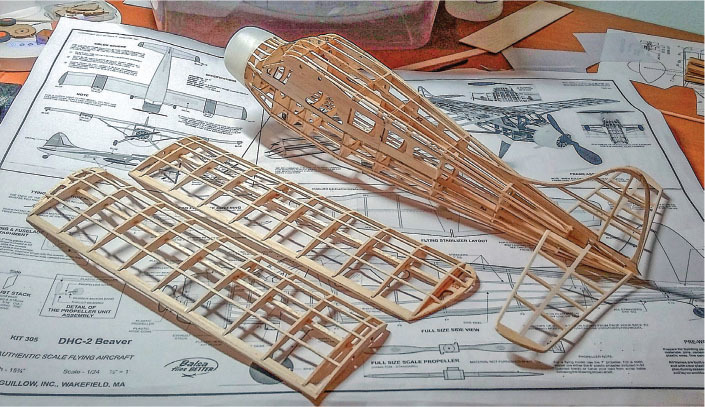
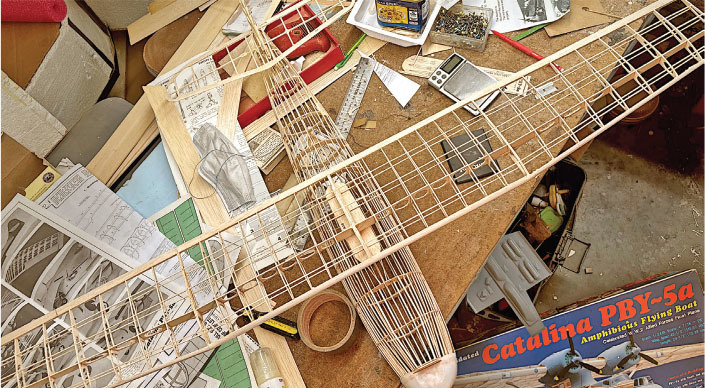
Many of my FF friends have finished three or four models for this celebration. We all try our best to embrace the goal of these builds and tap into our inner 12-yearold selves. In the upcoming August issue, you’ll see my first two projects, but for this column, I want to feature the wide variety of builds that have been built by others since the start of the year.
The biggest challenge is with the Modern Era kits because the wood is always a bit heavier than what a modeler who likes to scratch-build would use. Sometimes it’s three times heavier, so what is a modeler to do when they absolutely want to build that 28-inch P-40, but the wood is a bit on the hard side? Bring out the heavy-grit sanding block, along with the X-Acto knife, of course.
Sanding down a heavier 1/16-inch sheet of balsa parts can take some muscle, but I’ve seen a few people get them down to 60% of the original weight while retaining the die-cut or laser-cut shapes. Thinning the formers, along with the sheet leading edge and trailing edge, is probably the quickest way to drop the weight, although you must still be aware of the resulting structural integrity with this chop-chop approach.
Because today’s fliers like to load up the model with length and wider cross sections of rubber, the widening of the nose block is a must. The minimum is a 5/8-inch square opening for the 16-inch models, and wider as the wingspans increase. The rear motor peg can likely move forward a bay, and it’s always a good idea to keep an eye on the stabilizer size compared with the total wing area. As a good starting point to make the FF gods happy, use 25% for the stabilizer and 12.5% for the rudder.
I like my motors to weigh 25% to 35% of the finished model’s weight (without rubber inside), with a length of at least 2-1/2 to three times that of the propeller hook to the rear peg. These numbers usually give the model the chance to fly 60 seconds or more in the power stage. If the model has altitude when the rubber fades, it should lead to a reasonably long glide.

New Quick Release Multi-Rotor Hubs and Propellers!
Pat. No. 10,689,103
Visit the APC Prop website for more details about our efficient, high performance, balanced propellers. Over 600 types to choose from.
Proud Sponsor
The #1 Choice of Champions Worldwide!
Proudly Made in the USA!
Providing superior quality, unmatched variety and excellent service since 1989.
(530) 661-0399
APC Propellers are also available from your favorite online dealer or local hobby shop.
This is how I approach FF Rubber now as an adult with more than 35 years of rubber-power experience. If only I’d had the same knowledge back in the 1960s, when the fields were larger, less cluttered, and I had the freedom to ride my bike anywhere within a 5-mile radius without my parents paying that much of a concern. Yes, those were the days, but here we are now, and look at what we can do!
It’s time to dust off those old kits, bring out the glue, and start chopping some wood. You’ll be surprised at how quickly the old kit will come together, and, more importantly, how quickly you’ll remember that same vibe you had as a wide-eyed 12-year-old.
Dream, ponder, build, and inspire, but most of all … fly.
SOURCES:
National Free Flight Society (NFFS)
FAC
58 Free Classic Era Model Plans
Tom Hallman’s MaxFliArt YouTube Channel
"International Postal Flying Contest – Guillow’s 100th Anniversary"
YouTube
"Guillow’s International Postal Flying Contest ∗∗Indoor Update∗∗"
YouTube






Comments
Add new comment