IN THE AIR
By Holly Silvers, Associate Editor | [email protected]
As seen in the December 2026 issue of Model Aviation.
Have you ever wondered how AMA and the Civil Air Patrol (CAP) team up to support youth in aviation? In this Q & A, I asked AMA Education Development Coordinator Emily Rice to break down how AMA and CAP collaborate to help young pilots and aerospace enthusiasts launch their futures.
Holly Silvers: How do the AMA and CAP collaborate at a national level to promote STEM education and aerospace literacy among youth?
Emily Rice: At the national level, the AMA and CAP maintain a formal partnership established under a 2011 Memorandum of Understanding to advance aviation and STEM literacy across the nation. CAP promotes AMA initiatives across its nationwide network of more than 1,500 squadrons. Additionally, CAP’s Aerospace Education STEM Kit program equips Aerospace Education Officers (AEOs) and Educator Members with free, hands-on learning resources, including model aviation materials.
Both organizations also collaborate as members of the AERO Alliance, leveraging collective aviation and aerospace resources to cultivate awareness, encourage exploration, and prepare the future aerospace workforce with clear pathways into the industry.
HS: In what ways do local CAP cadet squadrons utilize AMA flying sites, instructors, or model aircraft programs (like sUAS/drones or flight simulators) for cadet aerospace training?
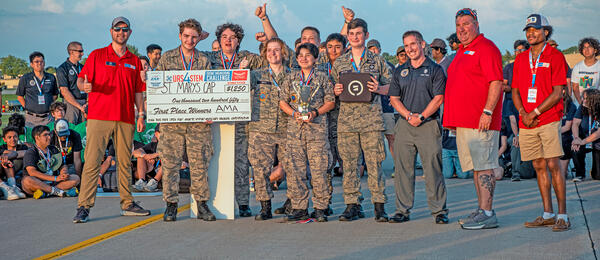
ER: AMA’s UAS4STEM drone engineering challenge is an excellent showcase for the AMA-CAP partnership. The competition challenges youth ages 11–19 to design, build, program, and operate small uncrewed aircraft systems (sUAS) for autonomous missions. Registering a CAP squadron grants joint membership in both CAP and AMA, unlocking access to AMA flying fields, experienced mentors, and specialized training resources. Competing in UAS4STEM allows cadets to fulfill CAP education requirements while building technical skills. This creates a seamless pathway toward FAA Remote Pilot certification, future aerospace careers, and unforgettable experiences flying alongside teammates.
In addition to UAS4STEM, CAP squadrons partner with AMA-chartered clubs to conduct hands-on RC flight training through the AMA’s Intro Pilot Program under the AMA Safety Code. Cadets sometimes build foundational skills on RC flight simulators supplied through CAP STEM Kits before stepping onto an AMA flying field for real-world stick time. Some CAP units also partner with AMA Clubs to launch model rockets.
HS: Are there standard joint events or outreach programs where CAP units and local AMA clubs co-host airshows, STEM expos, or model aviation workshops?
ER: Community aviation events offer ideal opportunities for AMA and CAP members to share their mutual passion for flight. For example, regional CAP squadrons regularly volunteer at the National Aeromodeling Championships (Nats) in Muncie, Indiana, assisting with event logistics, flight-line management, scoring, and public safety. Cadets earn leadership and community service hours while observing elite competition and networking with veteran RC pilots. Local clubs can easily mirror this model by inviting their nearest CAP squadron to co-host a joint fly-in.
General aviation gatherings, such as airport open houses or Experimental Aircraft Association (EAA) Young Eagle rallies, are also prime venue choices. AMA clubs can showcase static model displays alongside full-scale aircraft, while local CAP cadets present the colors and manage foot traffic, creating a win-win showcase for both organizations.
HS: How does involvement in both CAP and AMA help bridge the gap for young aviation enthusiasts transitioning from model aviation to real-world pilot training or aerospace careers?
ER: Model aviation serves as an accessible gateway to mastering core aeronautical principles. Learning to pilot RC aircraft on a simulator or at an AMA field promotes a foundational understanding of piloting skills. CAP builds upon this baseline: through its Cadet Wings program, qualified cadets receive full or partial funding to earn their FAA Private Pilot Certificate. When paired with UAS4STEM experience, students gain the foundational understanding that prepares them to obtain their FAA Part 107 certificate.
Cadets holding these ratings can participate in real-world CAP search-and-rescue or disaster-relief imaging missions. Combining RC flight experience with CAP aerospace training prepares youth for commercial flight operations, military aviation, uncrewed systems technology, aerospace engineering, air traffic control, and beyond.
HS: How do experienced adult AMA club members get involved as CAP Aerospace Education Officers or technical mentors to directly guide cadets through model building and flight operations?
ER: Adult AMA members can join CAP as Senior Members or Aerospace Education Members (AEMs). Modelers can also step into the role of unit Aerospace Education Officer (AEO), taking charge of designing hands-on aerospace lessons and model aviation projects for cadets.
Additionally, experienced fliers can serve as technical flight instructors through AMA’s Intro Pilot Program, guiding cadets through balsa and foam kit construction, radio transmitter setup, buddy-box flight instruction, and basic RC piloting. To get started, connect with your local CAP squadron using the unit finder link that is listed in “Sources.”
SOURCES:
Civil Air Patrol
CAP Unit Finder
AMA Flight School




Comments
Add new comment