I’VE FLOWN MODEL airplanes for 70 years without serious injury—until now. I’ve cut and burned myself in the shop, and I’ve had skinned knuckles from adjusting needle valves that were too close to propellers for my big hands, but I’ve kept my hands out of turning propellers.
Propeller safety is simple with internal-combustion engines. It takes very deliberate actions to start an engine, and if you intend to start it, you restrain the model so that it can’t move until you are ready to launch it or turn off the engine. If you know where the propeller is and where it will stay, you can remain well clear of it. You can work on mechanical or electronic controls on the model without any worry about the engine starting without warning.
Electric models use electronic controls with the same battery and ESC that power and control the motor. Separate power sources are possible, but we don’t use them because of weight, complexity, and reliability issues. Unfortunately, with that configuration, we can’t operate the secondary controls without having the propulsion active at the same time. Our decades of habits and procedures with internal combustion are not all directly relevant to electric power.
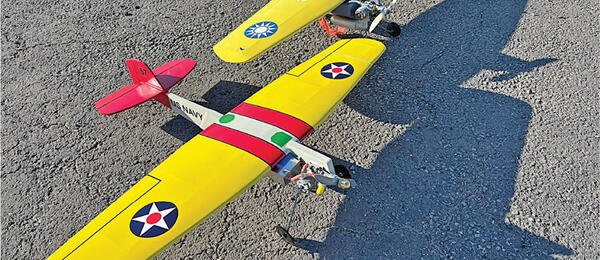
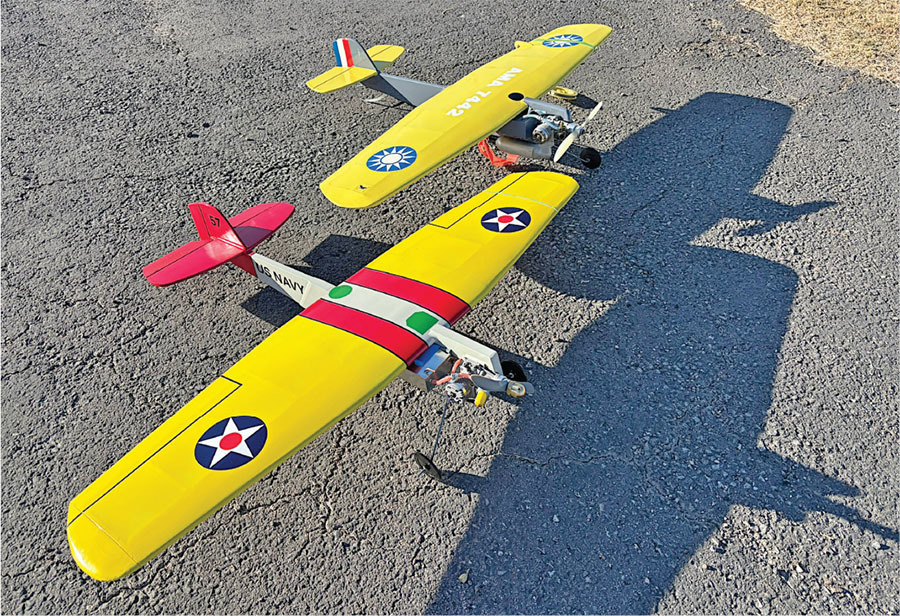
I was preparing my Class II electric Control Line (CL) Navy Carrier model at the Southwest Championship in Dallas and needed to ensure that the transmitter and receiver were functioning as required and that the controls were set to their proper starting positions—things that you really should check before you are called to fly! The checks require about 5 seconds to accomplish.
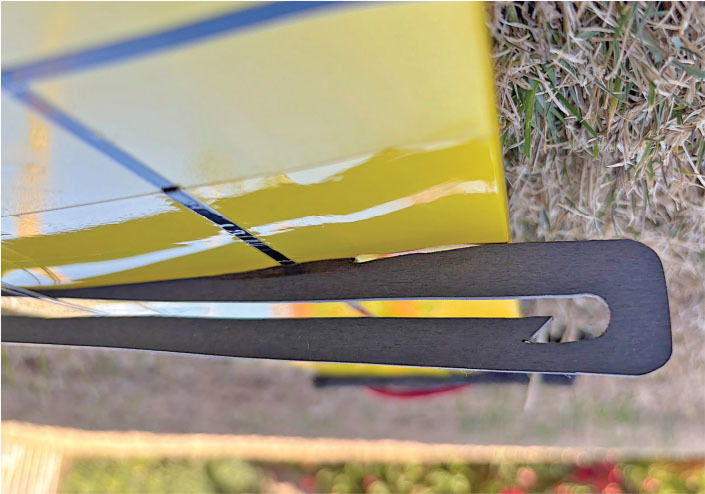
I could have used procedures that would have been safer. I could have called someone to assist me in restraining the model, but I didn’t. It was only a 5-second test, and nobody was close. I could have turned the model upright and restrained it using the tailhook over the edge of the worktable (my usual practice), but I didn’t.
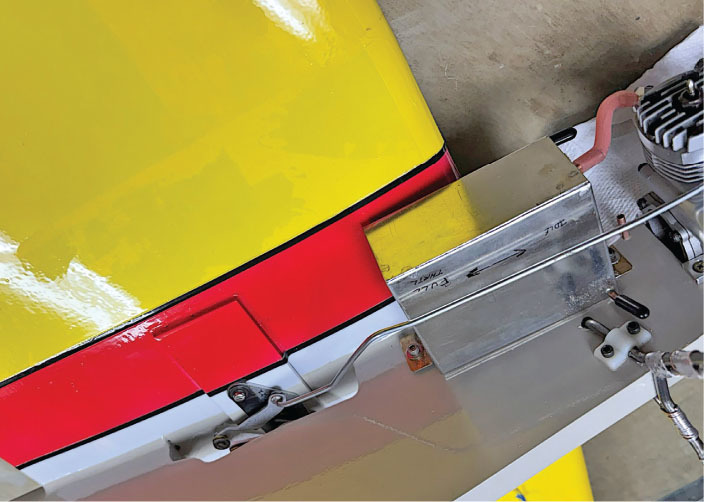
The line release and battery connection are under the wing. I could have removed the propeller (my usual procedure in the shop), but my propeller wrench wasn’t at the worktable. I had a lot of excuses to feed my complacency and allow me to avoid any of the rational safety procedures that I could have used.
I completed the tests and was putting the control handle on the table when the motor started unexpectedly at high power, pulling the model off of the table and into my left hand. I was preparing to enjoy the Southwest Championship contest, and a few tenths of a second later, I had a deep, 4-inch laceration from the first bone on my index finger to and around the base of my thumb.
My Boy Scout first-aid training kicked in. Immediately, I applied direct pressure to the wound to control the bleeding. A local driver took me to a relatively close emergency room, where the staff stabilized the bleeding and sutured and dressed the wound within two hours. Surgery to repair my severed tendon and the required rehabilitation will probably be complete by the time you read this magazine.
I don’t know—and might never discover—the reason that the motor started. Just as it would be at the shooting range, my finger was off the trigger until I needed to operate the throttle. I usually keep the transmitter at least 2 feet from the receiver, but my field worktable is 2 feet sq., so the receiver and transmitter were only a few inches apart. I’ve heard of receivers being swamped and failing to respond to transmitters in close proximity. I’ve never encountered that problem, but I’ve probably never had my transmitter that close with both turned on.
My failsafe setting is at partial throttle so that I do not lose a flight because of a momentary signal interruption. It’s possible that the receiver might have reverted to the failsafe mode, but I have only conjecture for that explanation. Asking someone to hold the model for my testing or removing the propeller would have resulted in a much more enjoyable contest experience and a lot less trauma.
Rules
AMA is accepting rules change proposals until March 15, 2027, for changes that will be in effect as of January 2028. I do not anticipate any changes to our rules in the current cycle. If you are thinking about submitting any changes, don’t miss the deadline. I am happy to discuss changes before they are submitted or even introduce ideas to the whole CL Navy Carrier Contest Board to address potential concerns and to help ensure adequate consideration during the accelerated amendment and voting process.
New Models
Jim Hoffman has campaigned a new MO-1 for the last year and is steadily improving as he experiments with trim and gains experience with the model. Jim’s September flights in Tucson, Arizona, resulted in a personal best.
The MO-1 is from one of the last Golden State kits, with some modifications by Jim made in consultation with me, Burt Brokaw, and Lou Wolgast. Dimensions are standard with the 10% airfoil. The wing and bellcrank mount joints are reinforced with dowels. Spruce leading and trailing edges in the tail surfaces increase durability. Nose doublers were lengthened, and the fuselage and tail were covered in 0.5-ounce fiberglass cloth.
Power is a Thunder Tiger .36 engine with an O.S. 4B engine carburetor fed from a Smith Model Products 5-ounce uniflow tank that was designed for Carrier flying. The model weighs 48 ounces with a 380-sq. in. wing. The next step is a Jett quarter-wave muffler to enhance high-speed performance.

FEED THAT ENGINE RIGHT OR ELSE YOU’RE GROUNDEDS
Make it a Flawless Flight with the
Vent
Pressure
+ many other sizes!
- Brass rotary fuel pick-up uses centrifugal force to ensure constant and reliable contact with fuel
- Three year warranty
- Zero maintenanoe
- Harder-hitting throttle
- No internal hoses or connections to harden, or leak air or fuel
- Works with gas, glow fuel and smoke oil
- Available in a variety of sizes ranging from 10 oz. ($29.95)–50 oz. ($49.95)
Check out our entire product line! www.jlproducts.net • (262) 628-3506 • [email protected]
Get Off to a Perfect Start with the
- Holds 1/4 ounce of fuel at the engine for an instant start and a constant supply
- Smoothes out fuel demand and irregular fuel surges from extreme flight
- Eliminates two fuel line connections Available in 2 or 3 line designs
- Price: $24.95
To fuel tank
To fuel dot
Patents pending
The MO-1 kit is long out of production, but plans are available from me with a list of upgrades.
Melvin Schuette came to Dallas with a new .15 Carrier model of the very obscure Curtiss XF13C. It is similar to the MO-1 in configuration, but is definitely a "No MO." It is a 25% enlargement of his XF13C that was published in the June 1990 issue of Model Aviation (plans number MA656). Airfoil thickness is increased to 15%, with a wing area of approximately 250 sq. in. and a 38-ounce flying weight. Power is a BadAss 2820-1820 Kv motor with an APC 8 × 4 pusher propeller and a 3S 3,000 mAh battery. The model uses a leadout guide that is adjustable both horizontally and vertically.
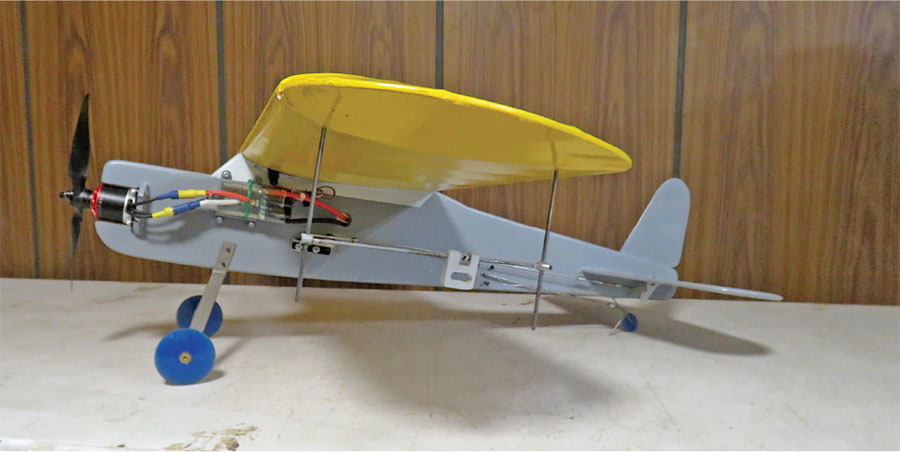
In its first contest appearance, Melvin achieved a very respectable 70-plus mph high speed and more than 2 minutes at low speed, with better low speed likely as he gains experience with the model.
That’s it for this installment. Keep your hook dry!







Comments
Add new comment