By Gordon Buckland | [email protected]
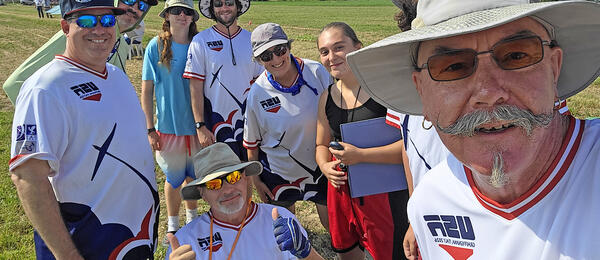
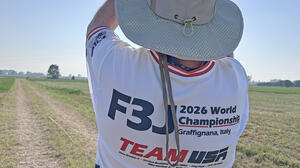
The 2026 FAI F3J World Championship for Model Gliders was held July 26-31 near Milan in Graffignana, Italy, in stifling, hot conditions. The USA team, consisting of pilots Dave Bradley, Jody Miller, Gordon Buckland, Amy Pool, and Junior John Bradley, along with Team Manager Mike Gardner and helper Kelly Johnson, assembled at a picturesque village called Cornegliano Laudense.
After two days of practice, preparations, and checking models and equipment, the World Cup pre-contest began. We separated into two three-man teams, and after eight preliminary rounds, three USA pilots made it into the flyoffs: Mike was in ninth place, I was in sixth place, and Jody was in first place.
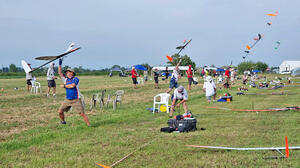
Three 15-minute flyoff rounds were conducted in easy thermal conditions, leading to very exciting rocket tows and low launches every round. Jody led the flyoff after two rounds, but he uncharacteristically sank out in round three for an early landing, making way for me to secure a spot on the podium in the bronze position with my three solid scores.
The main F3J World Championship event began after a day of model processing and registration. The first round saw slightly windy conditions of up to 10 mph, making the task of choosing to run with a thermal more difficult than all week. Amy was up first for the USA and had to relaunch at 2-1/2 minutes after hitting horrid sink. The sink also caught New Zealand’s legend, Joe Wurts, who also landed out around the 5-minute mark after a fruitless downwind sortie. He had to relaunch for a second attempt.
Dave was up second and had an uneventful flight right field and downwind, until he was back in the landing area and the bad sink caught him, requiring him to land 10 seconds early. I was up third and had a better-than-usual launch, so I took a few turns to see whether it was a thermal. I hooked up very quickly 100 meters downwind and specked for a great flight and a 9:55.20/98 landing for 1,000 points.
Jody, who was up in group four flying his Xplorer 3.5, launched so high that he just needed to start turning in the great air. He moved to the right during the flight to speck-out downwind ahead of the many models that were late to the party and returned at a much lower altitude with some relaunching. Jody hit 99 with 9:54.30 on the clock. With the first round over, we were all on the board with a decent start.
In the second round, each team member posted good scores. Jody led the way with a 9:53.80/98 to take 1,000 points, and Amy scoring 9:54.50/98 to take 1,000 as well. I was on time with my flight but right of the mark for a 9:55.60/96 and scored 993.8. Dave missed his landing too, with a 9:54.30/90 for 986.2.
Each day, the Italians served an excellent lunch with pasta/meat sauce, chicken salad, etc., during a 1-1/2-hour break.
I was first up for round three, and with a good read, I got off a little earlier, as did Joe, who was in the next lane. An uneventful climbout to a monster altitude was followed by a return to a landing that was better, at 97 with a 9:55.97.
The USA team worked extremely well together as we got into a good rhythm. The very hot, lifty conditions enabled great scoring throughout the rest of day one and most of day two.
The final round eight on day two was quite a setback for each of us because the extremely hot conditions seemingly saturated the air with lead balloons, and lift was fickle and really hard to find. Jody, Dave, and I all dropped time because each of us had a desperate struggle to contend with the rapidly changing air. Dave’s flight, in particular, was spectacular as he circled at 30 or 40 feet on the other side of the nearby power lines for more than 5 minutes, trying in vain to lift his model higher. He eventually landed out and a relaunch was required.
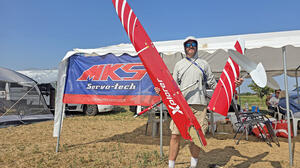
My eighth round was similar. I launched a little low and searched without success, and then I failed to reach the marked air of the pack at a sufficient altitude to work the weak lift. After 8 minutes, never getting over 150 feet and way downwind of the powerlines, I had to make a run for home. Threading the needle between the wires, I made it back on field but landed about 30 seconds early and 54 meters from the spot. I was rather fortunate to be awarded a reflight the next morning because the timing official failed to stop his watch and didn’t give me an official time.
Day three started badly; my round eight reflight yielded another early landing, completing a trio of underwhelming scores for Team USA. With the lowest score drop now in effect, our pilots were positioned with Jody on top in first place. I slipped to sixth place, and Dave was in 10th just a few points outside of the nine-pilot cut for the flyoffs.
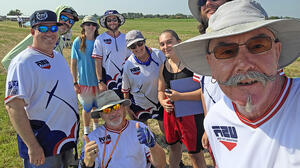
We needed a little luck to get Dave in, and that luck would come because Joe began watching the wrong model during the landing phase in round 12 and lost his model in the corn, which allowed Dave into the ninth flyoff spot.
Knowing that the team gold was at stake and that one more dropped flight would take it away, we worked hard all morning during the final rounds to find air for each other. Our good reads and teamwork saw us all perform well for solid scores to finish the 13 qualifying rounds. Jody was still in first place, I was in sixth place, and Dave was also in the flyoffs in ninth place. This was an amazing result! With some relief and much happiness and celebration, we secured the team gold for the USA!
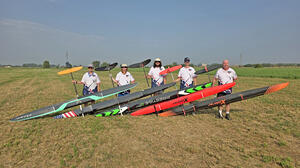
The Flyoffs
The first three flyoff rounds were flown in the afternoon, and Dave paired up with his brother, John, using the Junior team and equipment, and Jody used the USA team winches, with Kel Johnson as his thrower. I recruited German pilot Roland Kurtz and the German lane winches and had Mike, the USA team manager, as my thrower. Amy stepped up to help me, and I had a team.
The first 15-minute round was a good one because I scored 14:57.5/99 and matched Marco Galizia for 1,000 points. Jody also scored well with 14:55.3/99 for fourth place. Dave had a great time, but a slider on the hard ground took his model to 93.
The second flyoff saw Dave make a great comeback with 14:58.4/98. I took a really short tow for a great time, but a slider also resulted in a poor score of 14:58.2/91. Jody was very unfortunate because he was asked to return after an early launch, but he wasn’t told it was early until he was already 5 minutes into his flight. This error took Jody out of the contest.
Round three saw Dave and I both make poor landings again to finish the day a couple of points down in the standings, with me in fifth place and him in seventh. Both of us, however, were still in the hunt to win in the morning with good scores and some luck.
Day three ended with Jo Grini, of Norway, leading the way with solid flights and excellent 100-point landings.
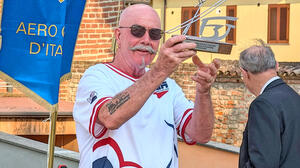
The final day four contest was scheduled for an early start and three more 15-minute rounds. I decided to take some chances and short-towed, but my luck ran out because the lift was not quite there in very light morning conditions and I required relaunches in both rounds four and five. I finally got it together in round six with 9:58.0/97. Dave and Jody’s flights were solid, but the star of the show was Italy’s Marco Galizia because he consistently put in the flights and landings to be crowned the individual gold medal pilot of the 2026 Worlds.
The most amazing pilot at this contest was Yu Nishimura, of Japan. He swept to a silver medal finish after just three months of practice in a discipline he had never flown before. It was miraculous success, but he is without doubt a very worthy and skillful pilot.
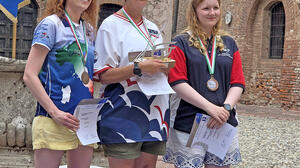
The bronze medal was awarded to Herman Haas, of Austria. Amy was awarded gold for being the number-one Women’s category pilot, with Australia’s Beth Loveday in second place and Norwegian Junior Thea Landseid in third place.
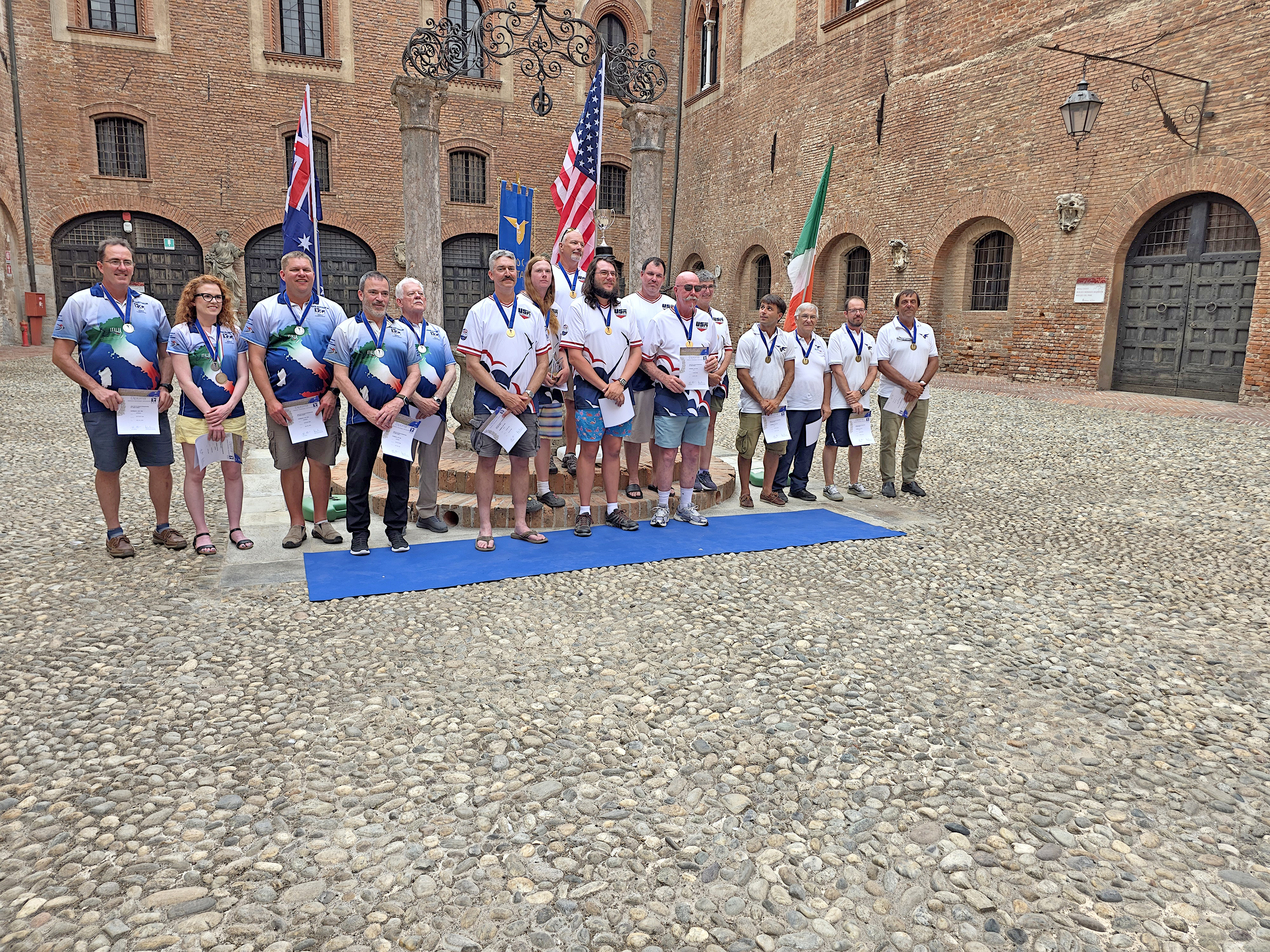
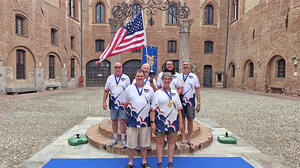
The contest came to an end with a huge success for the USA by winning the F3J World Championship Team gold. The team win is always our number-one priority, and that goal for 2026 was accomplished in fine style.
Team USA F3J is thankful for the amazing support of the RC Soaring community to make this success possible.
Go downwind and soar.
SOURCES:
League of Silent Flight (LSF)
silentflight.org
Team USA F3J
facebook.com/teamusaf3j
2026 F3J World Championship for Model Gliders
f3j.it/2026-f3j-world-championship/
“2026 F3J World Championship Recap”
RCGroups
rcgroups.com/forums/showthread.php?4932433




Comments
Add new comment