
THERE ARE TWO primary ways to satisfy the FAA’s Remote ID rule without the need of installing a broadcast module for your daily operations. The first is an FAARecognized Identification Area (FRIA), and the second is generally called a Remote ID Exemption (RIDE).
While both options allow flights without Remote ID modules, RIDEs are less common and have nuanced differences from FRIAs that can lead to confusion. This comparison outlines the basic distinctions and introduces the icon that is now available on AMA’s website. Clubs do not need to know which fits them best before applying; the same application is used for both, and AMA provides feedback when needed.


To help locate all approved sites, the FRIA and RIDE badges shown are listed on AMA’s Club Finder Tool to help identify fields.
What Do They Have in Common?
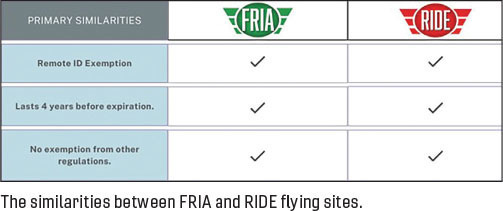
FRIAs and RIDEs are both FAA-approved areas in which pilots are not required to utilize Remote ID modules. The onlything FRIAs and RIDEs do is remove the requirement for Remote ID. They do not exempt the pilot from following any other FAA regulations, community-based organization (CBO) safety codes, site rules, or property laws. Once approved, they both last four years; however, RIDEs might expire sooner than four years depending on the club’s agreement with its landlord or local airport. FRIAs are valid for four years in all scenarios.
What Makes Them Different?
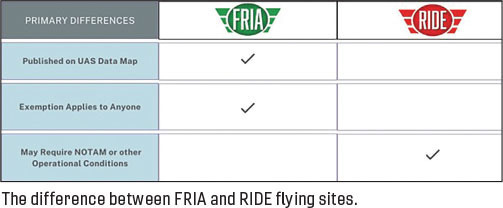
Once approved, FRIAs must be published on the public UAS Facility Map. Although they are filed by AMA with the name and number of an AMA club, a FRIA applies to anyonewithin the designated boundary. Additionally, FRIAs do not require clubs to issue and maintain a Notice to Airmen (NOTAM) for operation unless otherwise specified by a local agreement. For these reasons, FRIAs can be challenging to secure in spaces such as public parks or around airport property.
RIDEs, however, are tailored to the specific field in question, typically because that site was already denied for a FRIA. RIDEs are notlisted on the UAS Facility Map and they might include operational conditions, such as issuing a NOTAM before operations take place, or restricting certain days of the week. Clubs may choose to display their RIDE on the AMA website; otherwise, RIDEs remain private agreements and are not visible to the public. Additionally, the exemption given by RIDEs only applies to club members and their guests.
For these reasons, the FAA might find it easier to create and approve a RIDE for specific areas instead of a FRIA. Because each RIDE differs slightly, officers with questions about compliance should contact AMA at [email protected]for more information.
Why the Difference?
When FRIAs were first processed from 2023 through 2024, many applications were stuck in limbo or denied repeatedly. To ensure that we could acquire exemptions for any club that wanted them, AMA worked with the FAA to expand the process to include RIDEs. This offered a higher approval rate for complex sites, while still providing the same Remote ID relief.
Final Thoughts
We understand that navigating FAA requirements, FRIAs, and RIDEs can be frustrating; AMA is continuously working to advocate for simpler processes, regain more flying freedom, and to provide clear guidance to our members. All of this should help you focus on what matters most—flying safely and enjoyably.
SOURCES:
FAA Remote ID
FAA UAS Facility Map
AMA Government Affairs Blog
AMA Club Finder and Flying Site Search Tool







Comments
Add new comment