By Richard Machin | [email protected]
The successful maiden flight of a new AeroScout is pretty commonplace and hardly news. But what if the airplane has a 14-inch wingspan, runs on 12S power, and was scratch-built by a first-time foamy builder?
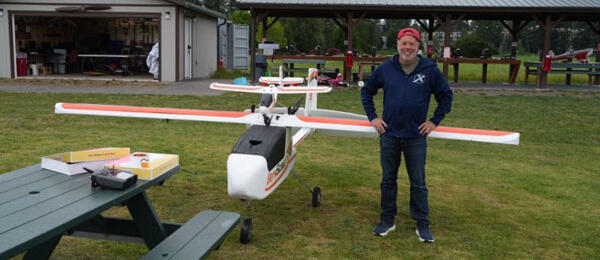
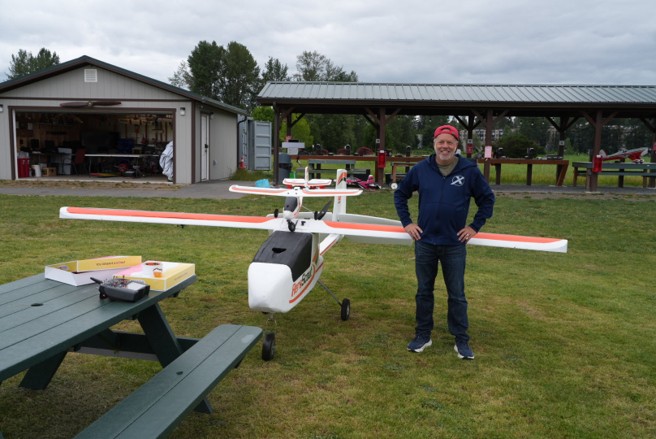
Chris Randall, nice president of the Marymoor RC Club in Redmond, Washington, was encouraged by the popularity of the AeroScout among youth members, and by their enthusiasm for experimental projects of all sorts. He said that the availability of online resources to help identify solutions for design and build challenges helped make his giant-scale project seem doable. Chris said, “I didn’t really know where to start. What tools, materials, skills I would need–I started with what I had–just plenty of enthusiasm and encouragement for the project.” Many hours and 18 months of work later, the finished airplane took to the air.
“I didn’t really know where to start. What tools, materials, skills I would need – I started with what I had – just plenty of enthusiasm and encouragement for the project.”
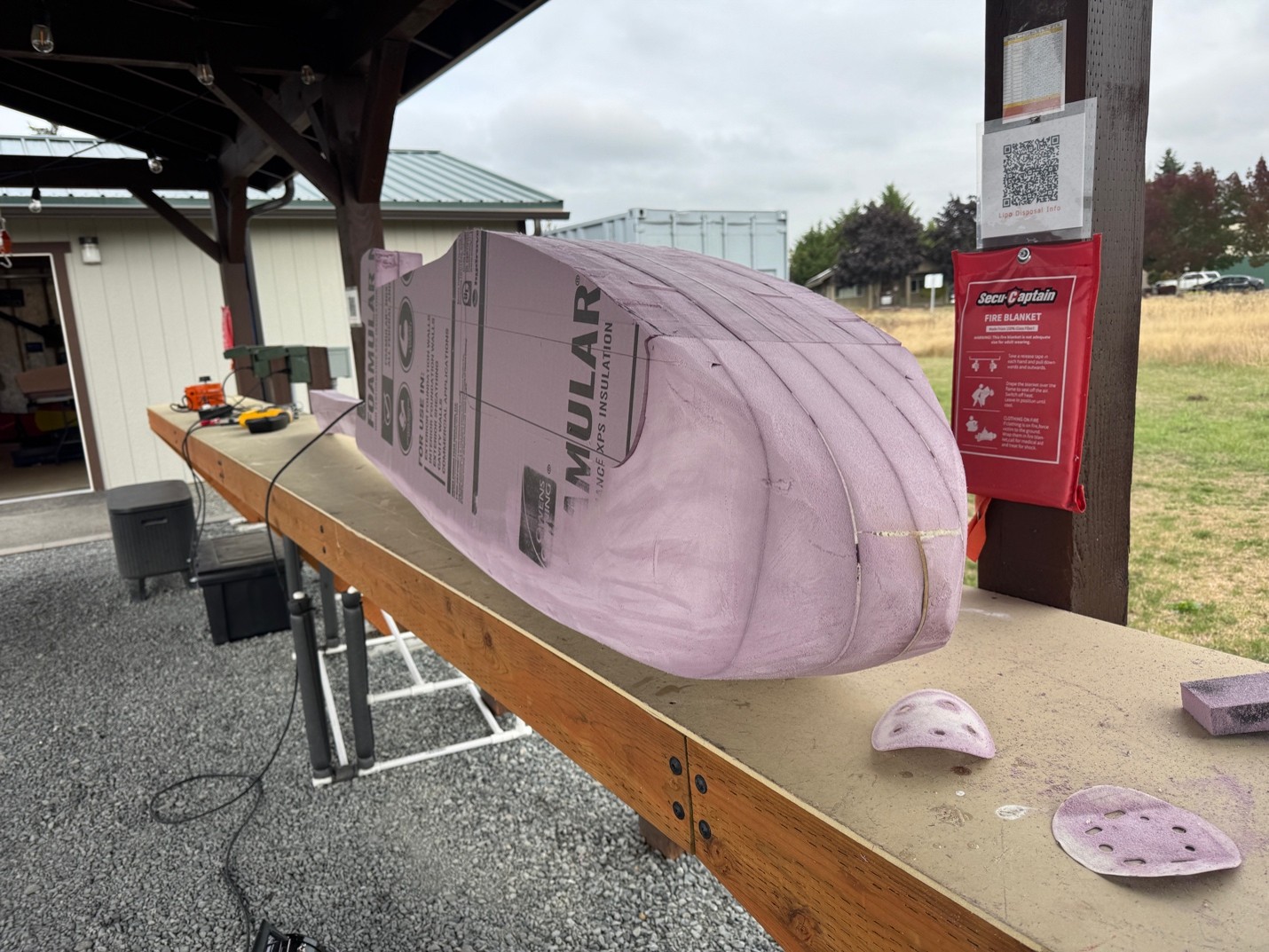
Chris began by scanning key parts of his HobbyZone airplane then scaling them up roughly four times before printing and cutting fiberboard templates. 4 x 8 sheets of pink foamboard from the hardware store helped determine the scale, but to get the correct wing profile they would need to be laminated together; several sheets were trashed before he found the right glue and a rigid structure. As part of this process, he designed and built a 7-foot hot-wire cutter to form the wing surfaces, and he cut channels in foam components, such as the tail boom, to lay-in carbon-fiber reinforcement.
Extreme Flight 140-inch Bushmaster gear provides the main wheels, and the largest wheel Dubro has to offer was sourced for the nose. Landing gear is bolted into plywood reinforcement, while the nosewheel pivots within a block of 2 x 4 lumber upfront. Wing mount issues were solved by scaling up the design of the originals, with two hand-tightened bolts clamping down the leading edge.
A particular challenge was the hinge for the huge elevator surface, for which Chris came up with a square-section carbon-fiber tube, secured within a bearing race which is, in turn, housed inside a piece of tail-mounted PVC pipe. This whole mechanism is driven by a pair of servos.
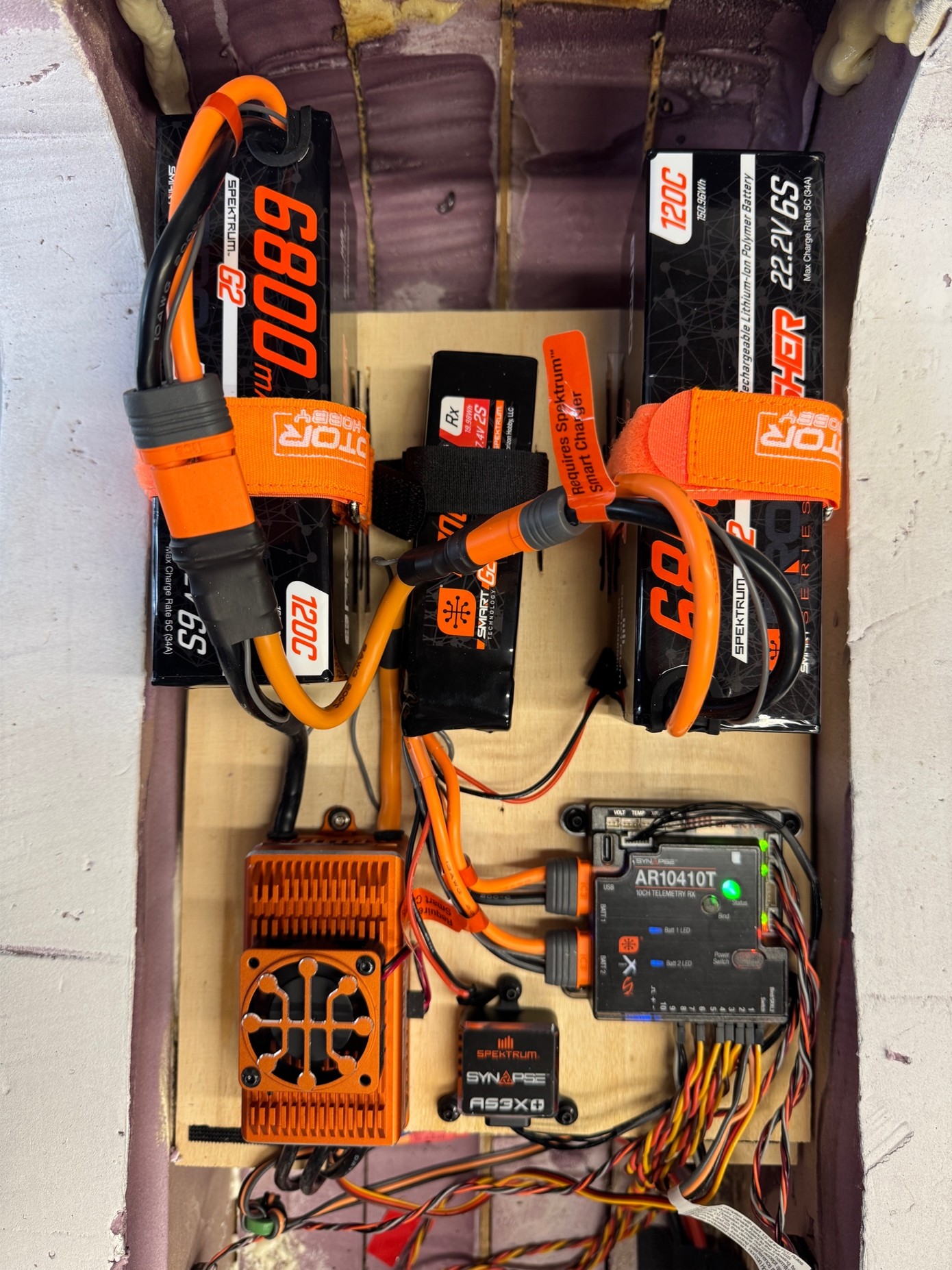
Five Savox 2290s, with a 40CC-size T-Motor juiced by a 12S powerplant driving the 22 x 10 carbon-fiber pusher propeller and it was receiver-ready. Now he had finished the airplane to the point where it was ready for its taxi test. Chris was pleased by its performance on the field but also struck by its appearance. “It was a pink monstrosity. Something had to be done to give it the classic visual appeal of the original,” Chris said. He had set out to make a giant-scale AeroScout, so it would need to fully look the part before he could call it done. He painted it the original black and white–still not good enough. He scaled up images of the original graphics in Photoshop and cut them in self-adhesive vinyl to produce that sharp, unmistakable look.
“It was a pink monstrosity. Something had to be done to give it the classic visual appeal of the original.”
At Joe Nall this year, Chris showed the Horizon crew photos of his creation. They were duly impressed. They asked him what radio he planned to use and were less impressed by his modest choice. “We’d feel more comfortable if you used this,” they said, and donated a 10-channel Spektrum PowerSafe receiver paired with a Synapse gyro. With that stamp of approval, the project was ready for its maiden flight.

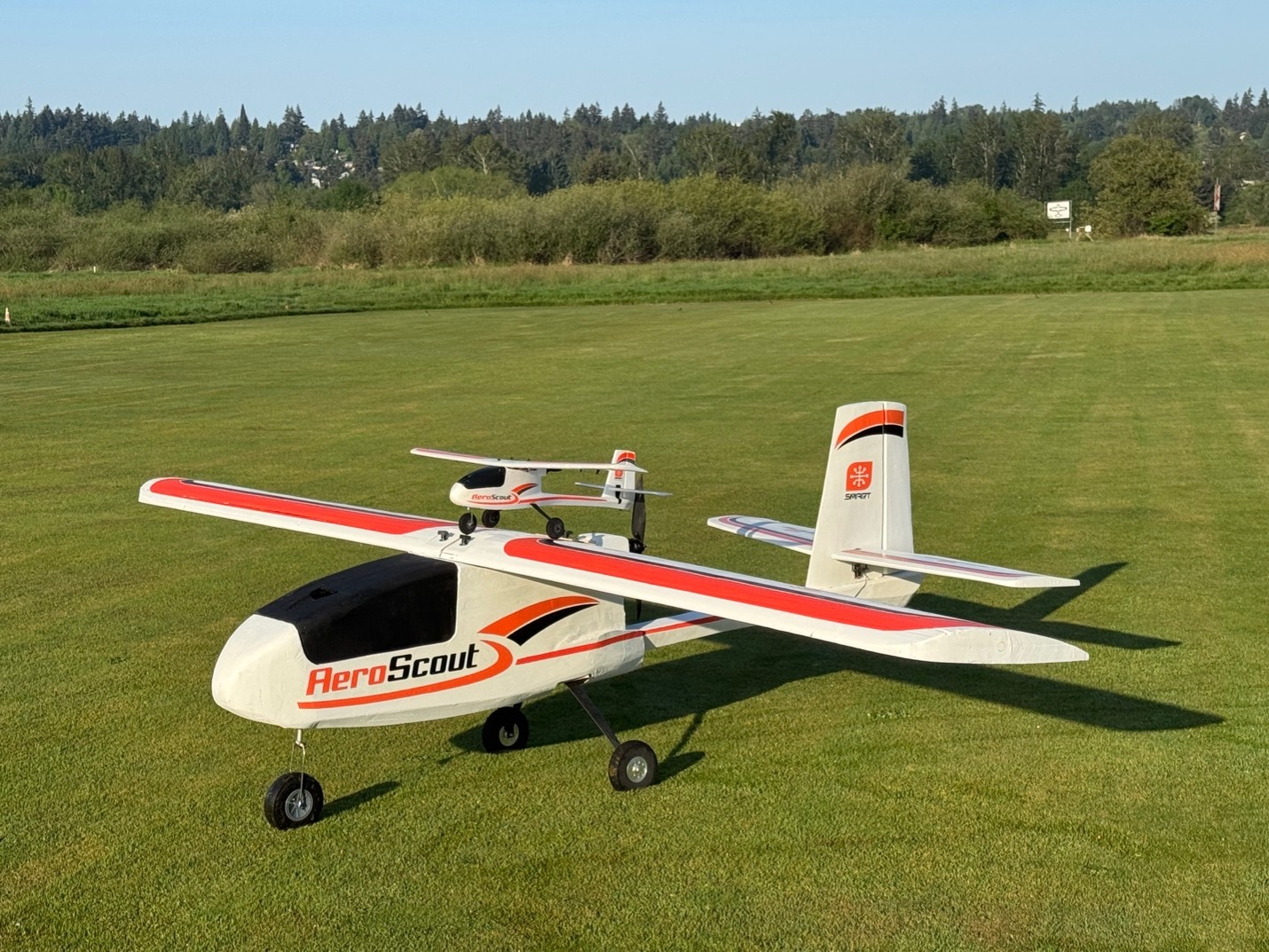
Glad to be able to put an end to the question, “When are you going to fly it?” that he had heard repeated over the last 12 months or so, Chris set a date–May 30. The Pacific Northwest weather complied, and a perfect Saturday saw the rollout of the airplane in front of a large crowd of spectators and fellow pilots and builders. It sat on the taxiway alongside its now miniature-looking sibling, with a backdrop of festive jazz music and the smell of summer barbecue. Chris said, “It was right then as I lined up on the runway that I got a little nervous. Here I was, about to launch some 51 pounds of insulation foam into the air for the first time. In front of half the club.”
“It was right then as I lined up on the runway that I got a little nervous. Here I was, about to launch some 51 pounds of insulation foam into the air for the first time. In front of half the club.”
A film crew stationed at the flightline followed the AeroScout as it roared into life before leaping from the ground. It flew perfectly, though its size made it harder to judge speed and distance. Chris also noted that managing throttle, bank, and sink rate on approach also took a little getting used to but after a couple of dramatic low passes for the cameras, a smooth landing took advantage of the full length of the runway. The airplane came to a graceful stop amid cheers and applause from assembled onlookers. Much backslapping and handshaking rounded off the event for a clearly pleased, and not a little relieved, pilot Chris. Would he do it all again? “Oh, I’ll be flying it again later today. But would I build another project like this? Not a chance!” he said.
Grab some popcorn and check the linked video of the maiden flight of the giant-scale AeroScout.
First flight http://bit.ly/4dVENn9
SOURCES:
Horizon Hobby https://www.horizonhobby.com
Spektrum https://www.spektrumrc.com
Savox https://www.teamsavox.com/
Pink Foamboard https://bit.ly/43Rz9fU





Comments
Add new comment